
Technical Assistance in Tunisia: Definition, Withholding Tax and Tax Treaty Treatment
For Tunisian companies engaging foreign service providers, the tax qualification of a technical assistance service is a key practical issue. It determines whether withholding tax applies, which rate should be used, and what supporting documents must be obtained before payment.

For Tunisian companies engaging foreign service providers, the tax qualification of a technical assistance service is a key practical issue. It determines whether withholding tax applies, which rate should be used, what supporting documents must be obtained before payment, and, more broadly, the level of tax risk associated with payments made to non-resident providers.
This article reviews the concept of technical assistance under Tunisian administrative doctrine, distinguishes it from know-how and the mere provision of manpower, and explains the tax treatment of payments made to non-resident service providers.
1. What is technical assistance?
According to Common Note No. 26/2012, technical assistance refers to a practical support operation whereby one person provides another with practical information relating to a specific profession. The concept does not cover a mere theoretical transfer of knowledge; rather, it implies operational involvement aimed at helping the beneficiary perform, organise or master a professional activity under practical conditions.
In practice, technical assistance often takes the form of qualified personnel being made available to support the client in production, sales, supervision, staff management or training operations. The decisive factor is not merely the presence of technicians or experts, but the active role they play in execution, monitoring and the transfer of a working method.
The qualification as technical assistance therefore requires several elements: direct involvement by the service provider, practical rather than purely theoretical content, the participation of personnel with specific expertise, and an effective transfer of experience to the beneficiary. This practical transfer, often referred to as “show-how”, enables the client to learn concretely how to carry out an operation, correct a process or improve its organisation.
Technical assistance may be performed in the country of the service recipient or elsewhere. The place where the service is physically carried out is not decisive in itself. What matters is that the service remains direct, practical and supervised, with genuine involvement by the provider in the transfer of experience and in supporting the beneficiary.
Examples of technical assistance include support for the start-up of a production unit, training the client’s teams in the use of a process, supervising the implementation of a technical system, temporarily supervising local staff, or assisting the beneficiary in organising its commercial or industrial operations. In all these cases, the service is characterised by active involvement, practical transfer and the technical responsibility of the provider.
Conversely, a service that is limited to the delivery of a manual, report, study, formula, technical documentation or information derived from previous experience, without support in its implementation, should not generally be treated as technical assistance. It may fall under another qualification, in particular the supply of know-how, where the provider transmits information without being involved in its practical use.
2. Technical assistance and know-how: what is the difference?
The distinction from know-how mainly depends on the degree of involvement of the provider. In a know-how arrangement, the provider communicates information derived from industrial, commercial or scientific experience, without necessarily intervening in its implementation. The provider transfers knowledge, but does not directly participate in its application.
By contrast, technical assistance involves active participation: the provider supports the beneficiary, supervises the practical application of its experience and contributes directly to the performance of the assignment. This distinction is important because it may affect the tax qualification of the amounts paid.
3. Technical assistance and the provision of manpower
Technical assistance should also be distinguished from the mere provision of manpower. Where a company simply supplies personnel to the requester, without technically directing the work or being responsible for the results achieved, the service does not necessarily constitute technical assistance.
However, where the personnel act under the instructions, control and responsibility of the provider, within the framework of a structured service aimed at transferring practical expertise, the qualification as technical assistance may be appropriate.
4. What tax treatment applies to technical assistance payments?
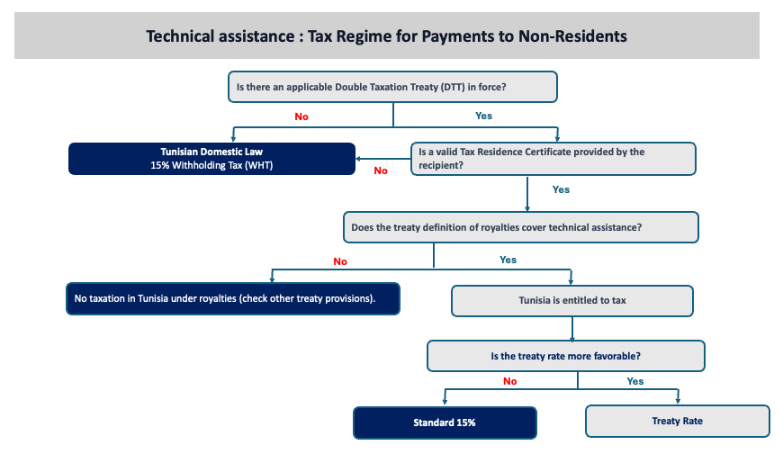
In the absence of an applicable double tax treaty, Tunisian domestic law applies. Payments made to a non-resident provider for technical assistance are therefore subject to withholding tax at the rate of 15% of the gross amount of the service.
Where a double tax treaty is applicable, the foreign provider must submit a tax residence certificate issued by the competent authorities of its country of residence in order to benefit from treaty provisions. Once this certificate has been provided, the definition of royalties under the relevant treaty must be reviewed to determine whether it covers technical assistance services.
If technical assistance falls within the treaty definition of royalties, Tunisia retains the right to tax the amounts paid, subject to the treaty rate where that rate is more favorable than the 15% rate provided under domestic law. If technical assistance is not covered by that definition, the amounts paid are not taxable in Tunisia as royalties. However, the other provisions of the treaty should still be examined, in particular those relating to business profits and the possible existence of a permanent establishment
Key points before paying a non-resident provider
- Determine the exact nature of the service: technical assistance, know-how or provision of manpower.
- Identify whether an applicable double tax treaty exists.
- Obtain the foreign provider’s tax residence certificate.
- Review the treaty definition of royalties.
- Compare the treaty rate with the 15% domestic withholding tax rate.
- Keep contracts, invoices, mission reports and supporting documents evidencing the reality of the service.
Professional caution
The tax treatment of a technical assistance service depends on the applicable tax treaty, the wording of the contract, the actual services performed and the available supporting documentation. A case-by-case analysis remains necessary before applying withholding tax or concluding that no tax is due in Tunisia.
Need assistance?
Before paying a non-resident provider for a technical assistance assignment, it is advisable to secure the tax qualification of the service, identify the applicable tax regime and properly document the file. Our firm can assist you with this analysis in order to reduce tax reassessment risks and secure your international transactions.